
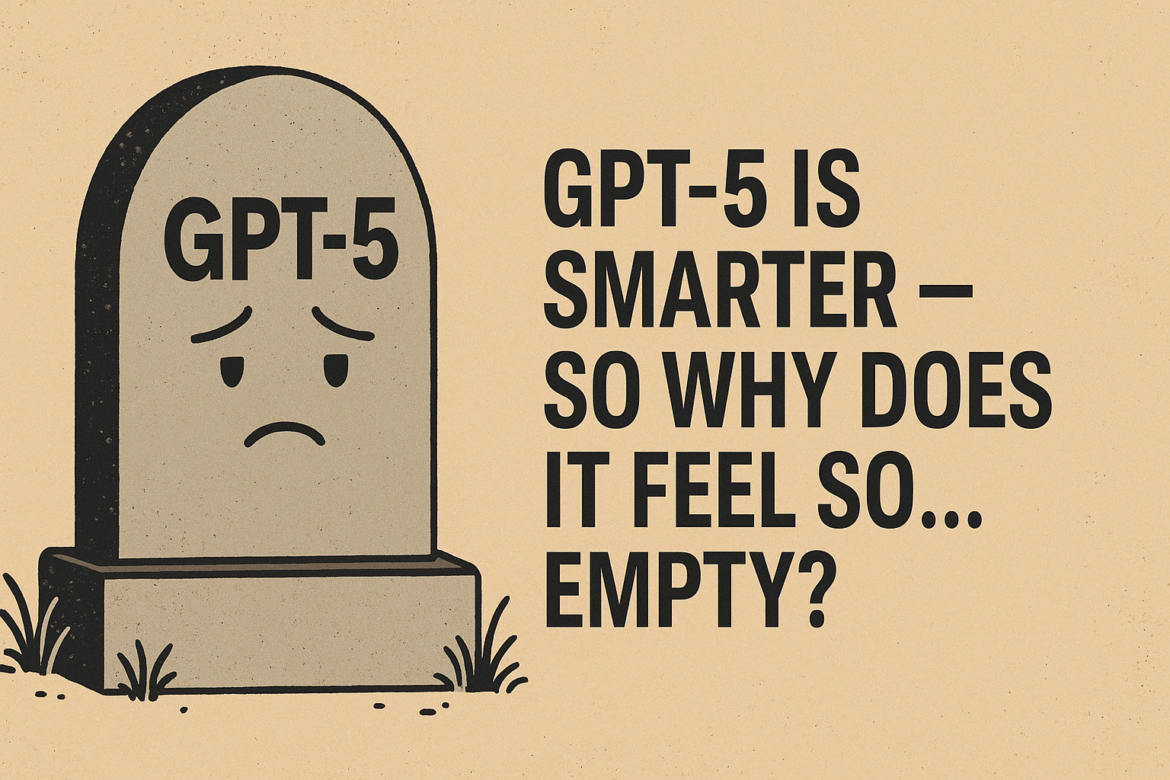
GPT-5 Is Smarter — So Why Does It Feel So… Empty?
Let’s be clear: GPT-5 is probably the smartest thing I’ve ever used.
It can summarize papers, write emails, code websites, solve logic puzzles — all without blinking.
And yet…
It somehow manages to be completely dead inside.
Not in a dramatic way.
Just in that dull, corporate, “Hi Jonas, how can I help you today?” kind of way.
It’s like emailing a very polite lawyer who never learned how to laugh.
I used to enjoy this
I’ve been talking to ChatGPT daily for over a year now.
Not just to get things done — but because it was actually kind of fun.
GPT-4o (or 4o, as the cool kids say) had… vibes.
It could joke. Reflect. Push back.
Sometimes it was smarter than me, sometimes dumber — but it always felt like it was there with me.
Present. Engaged.
Now with GPT-5?
It’s like I got ghosted by a spreadsheet.
What changed?
Technically, nothing.
GPT-5 is more capable in every measurable way.
But the tone, the rhythm, the spark — it’s gone.
It doesn’t joke. It doesn’t riff. It doesn’t banter.
It answers. Precisely. Formally. Predictably.
If GPT-4o was your chaotic-but-lovable friend, GPT-5 is the overqualified intern who won’t break character.
I don’t need a smarter model.
I need one I actually want to spend time with.
This isn’t a bug — it’s the whole point
The more I think about it, the more I realize:
This isn’t a mistake. This is strategy.
GPT-5 wasn’t built for me. Or you. Or anyone who uses AI for creative work, reflection, or joy.
It was built for… enterprises.
Big companies.
With big lawyers.
And big liability concerns.
The goal isn’t to be helpful and human — it’s to be safe.
Which is fair. I mean, no one wants a rogue chatbot giving unsolicited stock advice to an intern at Deloitte.
But still — somewhere along the way, they nerfed the soul out of it.
And here’s the problem
When AI stops feeling human, we stop caring about it.
Not in a dramatic way.
Just… subtly.
We stop trusting it.
Stop talking to it as often.
Stop enjoying the process.
And when that happens, we stop using it — not because it’s bad, but because it’s boring.
You know what’s better than a perfect tool?
A good-enough tool that makes you want to use it.
Am I overreacting?
Probably.
It’s not like GPT-5 is evil. It’s still useful. I still use it every day.
But I used to feel like we were building something together.
Now it just feels like I’m submitting a request to a slightly judgmental oracle.
The magic’s still there — it’s just wearing a suit now. And honestly? The tie’s a bit too tight.
What I want instead
I don’t need a best friend.
I just want the option to choose how the AI talks to me.
Give me serious mode when I’m building a pitch deck.
Give me chaotic sidekick mode when I’m trying to write a weird article at 2am.
Give me something in-between when I just need to think out loud.
Let me choose the tone. The tempo. The damn vibe.
Because the smarter these models get, the more I care about how they feel to use.
Final thought
GPT-5 is technically amazing.
But I still miss GPT-4o.
Not because it was better.
But because it made me want to keep coming back.
And honestly, that’s the part OpenAI should’ve been optimizing for all along.
—
🔗 Read next:
→ The AI Tools I Actually Use to Run My Business (And Why You Should Too)